




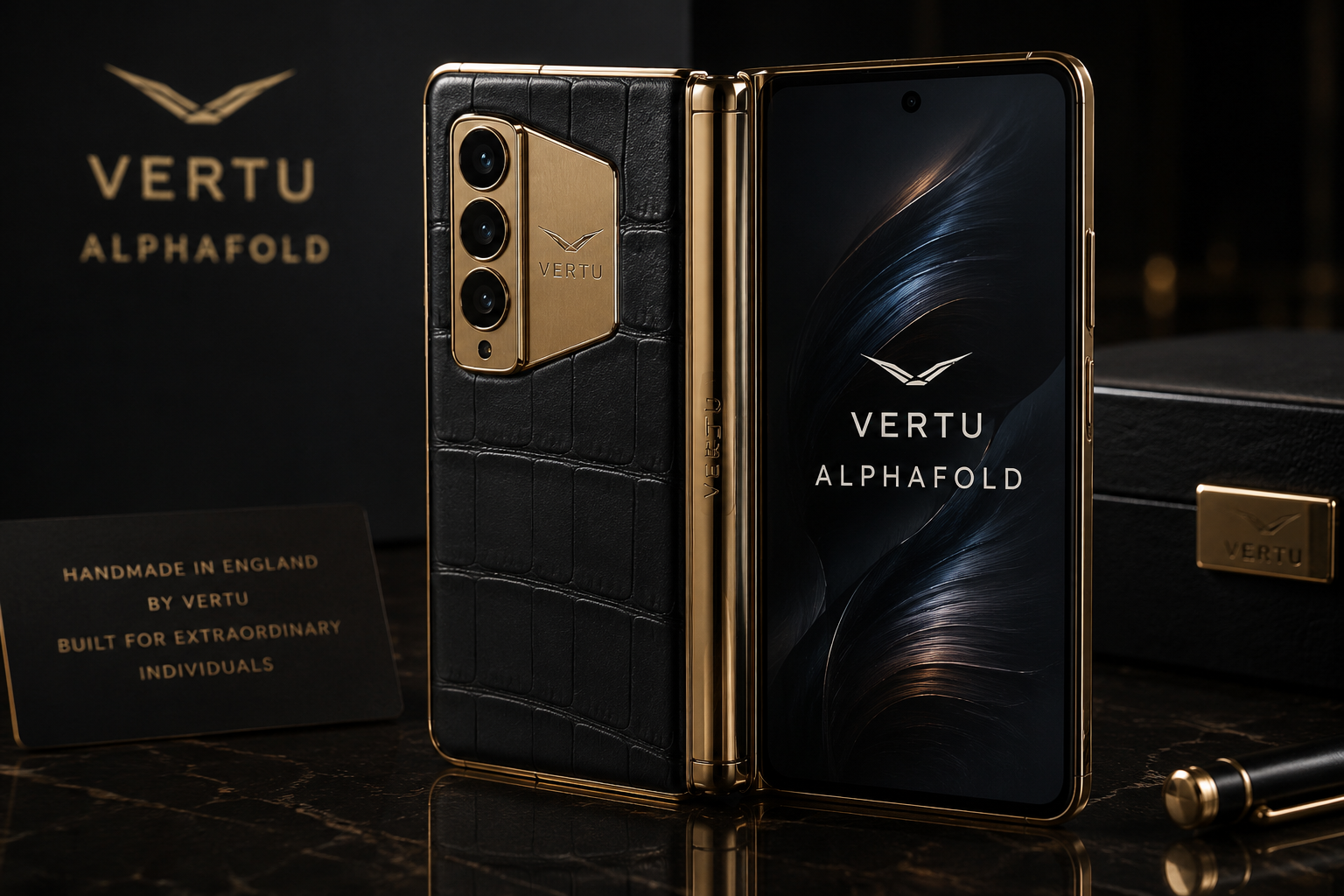
Most people scrolling foldable phone news are comparing megapixels and hinge warranties. Vertu is not interested in that conversation. The British-born, Hong Kong-based luxury house has unveiled the Alphafold, its first book-style foldable smartphone, and priced it like a timepiece rather than a gadget. It starts at a jaw-dropping $6,880 and climbs, depending on materials, all the way to $46,800 for a gold-and-diamond edition. For context, that top price is roughly what you would pay for a small car, not a phone.
The Price: What $6,880 to $46,800 Actually Buys
Vertu structures the Alphafold’s pricing around materials rather than internal specification tiers, which is unusual for a smartphone launch. The entry point is a calfskin leather model at $6,880. Step up to genuine alligator leather and the price rises to $8,800. From there, Vertu offers bespoke finishes: 18-karat gold detailing and diamond accents push the ticket as high as $46,800 for the most extravagant configuration reported at launch.
| Edition | Material | Starting Price (USD) |
| Standard | Calfskin leather | $6,880 |
| Premium | Alligator leather | $8,800 |
| Bespoke | Gold detailing / diamond accents | up to $46,800 |
Caption: Alphafold pricing scales with material choice rather than chip or memory upgrades, a hallmark of Vertu’s craftsmanship-first sales pitch.
That places the Alphafold several times above flagship foldables from Samsung, Oppo and Huawei, and even ahead of most other Vertu devices: the brand’s Quantum Flip starts near $5,700, while its Ironflip range runs from about $4,500 to $12,090.
Key Features: Craftsmanship Meets an AI Business Agent
Strip away the leather and gemstones and the Alphafold is a genuine book-style foldable with flagship-class internals. It pairs a 6.53-inch cover display with an 8.05-inch inner screen, both LTPO OLED panels running at 120Hz. The hinge itself uses titanium and liquid metal construction that Vertu rates for roughly 650,000 folds, protected by ultra-thin glass. Power comes from Qualcomm’s Snapdragon 8 Elite Gen 4 chipset, paired with 16GB of RAM and a fixed 1TB of storage. On the back sits a triple camera system: a 50-megapixel main sensor, a 50-megapixel ultrawide, and a 5-megapixel telephoto lens. A 6,500mAh battery and satellite communication round out the hardware sheet.
“The Alphafold isn’t chasing camera supremacy; it’s selling an AI agent wrapped in exotic leather and gold.”
The real headline feature, though, is software. The Alphafold runs Hermes Agent, an AI assistant built on the open-source Hermes project from Nous Research. Rather than acting as a simple chatbot, Hermes Agent is designed to handle scheduling, workflow approvals, travel planning, sales tracking and other operational tasks through plain language commands. Vertu says the agent can route requests across multiple large language models, including OpenAI’s GPT, Anthropic’s Claude and Google’s Gemini, and connect with more than 80 apps and enterprise systems such as ERP and CRM platforms, alongside everyday services like Gmail, Google Calendar, Maps, WhatsApp, Telegram, Facebook and Amazon.
Security is pitched as a companion feature to that automation. Vertu says sensitive data processing can happen locally on the device using a dedicated A5 security chip, while higher-risk actions such as financial approvals still require the owner’s manual confirmation before the agent proceeds. For enterprise buyers, Vertu also offers tailored Phone-to-ERP and private server deployments, with pricing on that side handled case by case.
- 6.53-inch cover display and 8.05-inch inner display, both 120Hz LTPO OLED
- Titanium and liquid-metal hinge rated for around 650,000 folds
- Snapdragon 8 Elite Gen 4 chipset, 16GB RAM, 1TB fixed storage
- Triple rear camera: 50MP main, 50MP ultrawide, 5MP telephoto
- 6,500mAh battery with satellite communication support
- Hermes Agent AI assistant with multi-model routing and 80+ app integrations
- Dedicated A5 security chip for local, on-device data processing
- Calfskin, alligator leather, gold and diamond finish options
How It Came to Be: A Brand Built to Sell Status, Not Specs
Vertu’s story begins inside Nokia. Between 1998 and 2002, Nokia designer Frank Nuovo led the development of what became the world’s first purpose-built luxury phone brand, launching the handcrafted Vertu Signature with a sapphire crystal screen, titanium body and hand-finished components. It was followed by the sports-car-inspired Ascent, and the two models established a template (precious materials, artisanal assembly and a concierge “Ruby Key” service) that the brand has leaned on ever since.
Vertu was later spun off from Nokia and passed through several owners over the following decade, weathering periods of financial trouble and relaunching more than once under new investors. The company that carries the name today is based in Hong Kong and has repositioned itself around foldable hardware and AI, following up 2025’s business-focused Agent Q with the Alphafold in 2026. Notably, reporting on the launch has pointed out that the Alphafold’s core hardware platform is understood to be based on a Nubia Fold device, with Vertu applying its own materials, design language and software layer on top, a sourcing approach the brand has used on past models as well.
Key Markets: Where Vertu Actually Sells
Vertu’s customer base has always been narrow by design. The brand’s strongest historical markets are mainland China, the Middle East and Europe, regions where brand recognition among wealthy buyers runs deep and where luxury spending has kept growing. Asia-Pacific alone now accounts for close to 40% of the global luxury goods market, and rising numbers of high-net-worth individuals across China, Japan and Singapore give Vertu a natural audience for six-figure-shilling-range hardware.
The Middle East remains a stronghold thanks to its concentration of wealthy buyers and appetite for exclusive, customisable products, while Europe continues to reward Vertu’s craftsmanship story. More recently, the company has also flagged the United States as a fast-growing market, with executives noting that more than half of its online sales in recent years have come from American buyers, a shift from Vertu’s earlier decades, when the US was a comparatively small part of the business.
Why It Matters
On paper, the Alphafold is easy to dismiss: foldables still make up under 2% of global smartphone shipments, and a nearly $7,000 starting price puts it entirely outside the market most readers will ever shop in. But the phone is a useful signal of where the luxury-tech segment is heading. Vertu is betting that AI agents, not cameras or chipsets, will be the next status symbol for executives who already own every other flagship, packaging enterprise automation as a hand-finished, materially rare object rather than a software feature.
It also matters as a broader industry marker. If AI agents that handle approvals, scheduling and cross-platform workflows become a genuine selling point on a $6,880 phone, mainstream brands are likely to push similar tools down into far more affordable devices over the next few product cycles. For most buyers in Kenya and beyond, the Alphafold itself will remain a curiosity rather than a shopping-list item, but the AI-agent trend it is chasing almost certainly will not.
Prices and specifications reflect information available at launch and may vary by region and configuration. Figures are quoted in US dollars as reported by Vertu and industry press. This article is for informational purposes and is not sponsored by Vertu.
